
01
Deep processing
Processes what is happening around them in greater detail.
Applied research project
ASSMA is aimed at students from 6th grade of Primary Education to 4th year of ESO and studies how sensory processing sensitivity relates to mental health, risk factors and protective factors in the educational context.
No obligation · we explain the scope, permissions and timeline.








Why ASSMA exists
ASSMA does not diagnose.
It generates evidence on how sensitivity
and context influence adolescent mental health.
 ASSMA team · Applied research in schools
The project
ASSMA studies the relationship between sensory processing sensitivity and mental health in school-aged adolescents. Its aim is to generate useful knowledge to better understand how family, school and personal contexts influence this stage.
The project is designed to produce evidence that can improve prevention, educational guidance and early support, without presenting the platform as an automatic diagnostic system.
In brief
Access. Students and the team access the application; the recommended public channel for information and participation is direct contact with the team.
Application accessThe trait
Sensory Processing Sensitivity (SPS) is a temperamental trait: a way of processing information with greater depth, stronger emotional reactivity, sensitivity to subtle environmental cues and possible overstimulation under intense stimulus load. It is not a disorder or a clinical label.
Everyone has sensitivity to some degree: research describes low, medium and high levels of sensitivity. In adolescence, higher sensitivity can translate into both strengths and challenges, because more sensitive people tend to be more affected by their environment, both adverse and supportive.
Processes what is happening around them in greater detail.
Experiences emotions with greater intensity.
Notices changes or cues that may go unnoticed.
Can become saturated by excess noise, pressure or sensory load.
Neither high nor low sensitivity is "better": each level of the trait involves strengths and challenges depending on the context.
Theoretical framework: Aron y Aron (1997); Pluess (2015); Lionetti et al. (2018).
Project principles
SPS is a trait, not a disorder or a deficit.
Family, classroom and relationships matter as much as the trait.
Every participation process requires clear information and explicit authorisation.
Public reporting is always presented in aggregate form.
Results are interpreted by professional teams.
The focus is prevention and early support.
Leadership, tutors, guidance teams and families coordinate.
Access is restricted to the team and the authorised school.
Reference to GDPR and research with minors.
The research is returned to the educational community.
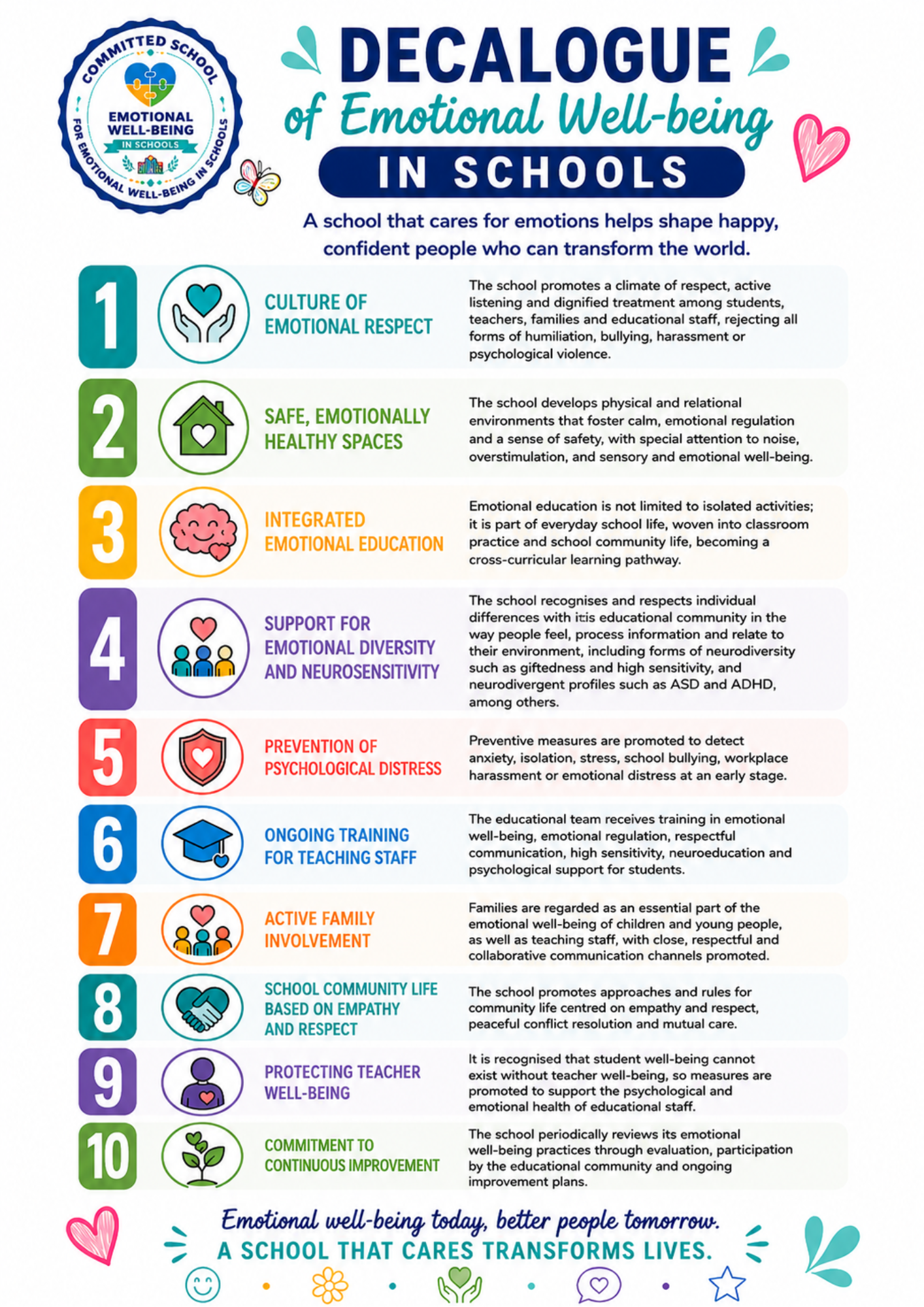
PAS España resource
A PAS España initiative with ten commitments to build more humane, safe and inclusive educational environments: coexistence and respect, emotional education, prevention of psychological distress, attention to neurodiversity and high sensitivity, teacher well-being and family participation.
Joining is voluntary and ethical-institutional in nature: a tool for awareness and continuous improvement, not an administrative accreditation process or a clinical certification.
How to join
Available seals
Both seals come from the same voluntary membership; they are not different levels.
ASSMA video
A direct presentation to understand the scope, purpose and way to take part in ASSMA before requesting information for your school.
Supported by
Request information, receive the decalogue and, if it fits, the team will explain the scope, permissions and timeline. No obligation.